Technology vs. Human Touch
- Jul 23, 2026
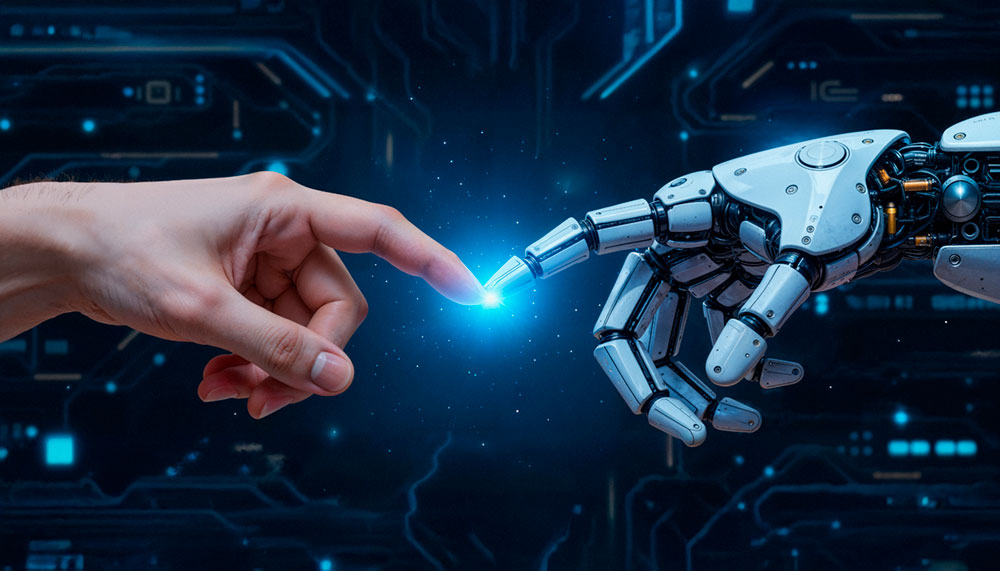
Technology has touched every aspect of human life, making life easier, more efficient, and safer for us. We have indeed reached a point where life without technology seems impossible. Innovations such as smartphones, the internet, cloud computing, and automation have become indispensable parts of our lives. And at the forefront of this technological revolution is artificial intelligence (AI).
The AI Era
We are living in the age of AI. From transforming industries and workspaces to assisting with everyday household tasks, AI has become so embedded in our lives that it makes us wonder how we ever managed without it!
It is widely used in a variety of work settings and has become equally common in our homes. Even for a simple search we no longer sift through the search results but instead rely on the concise AI-generated overviews provided conveniently for us. AI has slowly but surely left its mark on nearly every aspect of modern life.
The Generative AI Boom
Among its many forms, generative AI has emerged as a true game changer. Traditional AI use was typically limited to predictions or data classifications, but generative AI goes a step further. As the name implies, it generates new content based on the massive data sets it has been trained on. Its adoption has been rapid, even surpassing the pace at which personal computers (PCs) were embraced.
In today’s world, AI is being used in fields such as education, healthcare, business, and more. Its benefits of efficiency and speed make it impossible to ignore; it undoubtedly makes lives easier and the time savings it results in are huge.
But its growing presence raises an important question: How much can we rely on AI, and can technology actually replace the human touch?
Applications of Generative AI
AI is used across industries with its reach only expanding further and becoming an integral part of our lives. Let us take a look at some of the areas where it has made an impact:
Where AI Falls Short
We have seen the very many applications of AI. But the question remains: Can AI replace humans? And the answer is startlingly simple: No, it cannot.
With all its advantages, there are some human qualities AI just cannot replicate. Traits like compassion, emotional intelligence, value-based decision making, intuition, creativity, purpose, self-awareness, and consciousness are all deeply human in nature. These are qualities that are unique to humans and many of them are built through lived experiences and personal growth over time.
Through its ability to learn, AI can at the maximum imitate these qualities. It cannot feel them.
Finally, let us not forget that AI is not infallible. It too can make mistakes and generate inaccurate results, making human supervision necessary.
It’s Not Technology vs. Human Touch but Technology with a Human Touch -H2
Collaboration, not competition, is the way forward: Technology and humans working together, each building on the other’s strengths and cancelling out the weaknesses.
AI can process huge amounts of data and do repetitive tasks without tiring. It can work around the clock, analyse information at an incredible speed, and improve performance across industries. Humans, on the other hand, not only bring qualities AI cannot replicate, but also something more essential: a human presence that fulfils a fundamental need for connection and belonging.
Combine AI and human touch, and we have a powerful partnership that blends efficiency with empathy, resulting in outcomes far greater than what each can individually achieve.
Frequently Asked Questions
Can AI replace the human touch?
No. AI can automate tasks, analyse information and generate useful content, but it cannot genuinely experience compassion, emotions, lived experiences or human connection. The most effective approach is to use AI to support people while keeping human judgement and empathy at the centre.
What are the main limitations of artificial intelligence?
AI can produce inaccurate information and does not possess human consciousness, personal experience or genuine emotional understanding. It can imitate empathetic communication, but its responses are generated from learned patterns rather than feelings or lived experiences.
How can AI and humans work together effectively?
AI can handle data-heavy, repetitive and time-consuming tasks, while people provide judgement, creativity, empathy and ethical decision-making. Combining these strengths can improve efficiency without losing the human perspective.
Why is human connection still important in the age of AI?
Human connection provides empathy, trust, emotional support and a sense of belonging that technology cannot genuinely experience. These qualities remain particularly important in areas such as healthcare, education, relationships and other situations involving complex human needs.
How is generative AI changing everyday life?
Generative AI can help people create content, find information, solve problems and complete routine tasks more quickly. It is increasingly being used in workplaces, education, healthcare and creative fields, while human oversight remains important because AI can make mistakes.
Why is human empathy important in healthcare when using AI?
AI can support diagnosis, data analysis, personalised care and administrative tasks, but healthcare also requires listening, compassion, reassurance and understanding a patient's individual circumstances. Human healthcare professionals remain essential for providing this emotional and relational dimension of care.
Is the future of technology about AI replacing humans or working with them?
The stronger model is collaboration rather than replacement. AI can provide speed, scale and data-processing capabilities, while humans contribute empathy, creativity, values, judgement and meaningful relationships. Together, technology and people can achieve outcomes that neither could provide as effectively alone.