Continuous Improvement with 5S and Kaizen
- Jul 08, 2025
Overview:
The 5S and Kaizen are proven Japanese methodologies to improve workplace organization and efficiency. The blog explains what they are and the benefits of using them.
5S and Kaizen are both Japanese approaches that are aimed at improving the productivity of an organization. While 5S was first used by the Toyota Production System in the 1960s, Kaizen emerged earlier, in the 1950s, with influence from the American quality control methods. While they are two different methodologies, they are often used in conjunction as they complement each other very well.
What Is 5S?
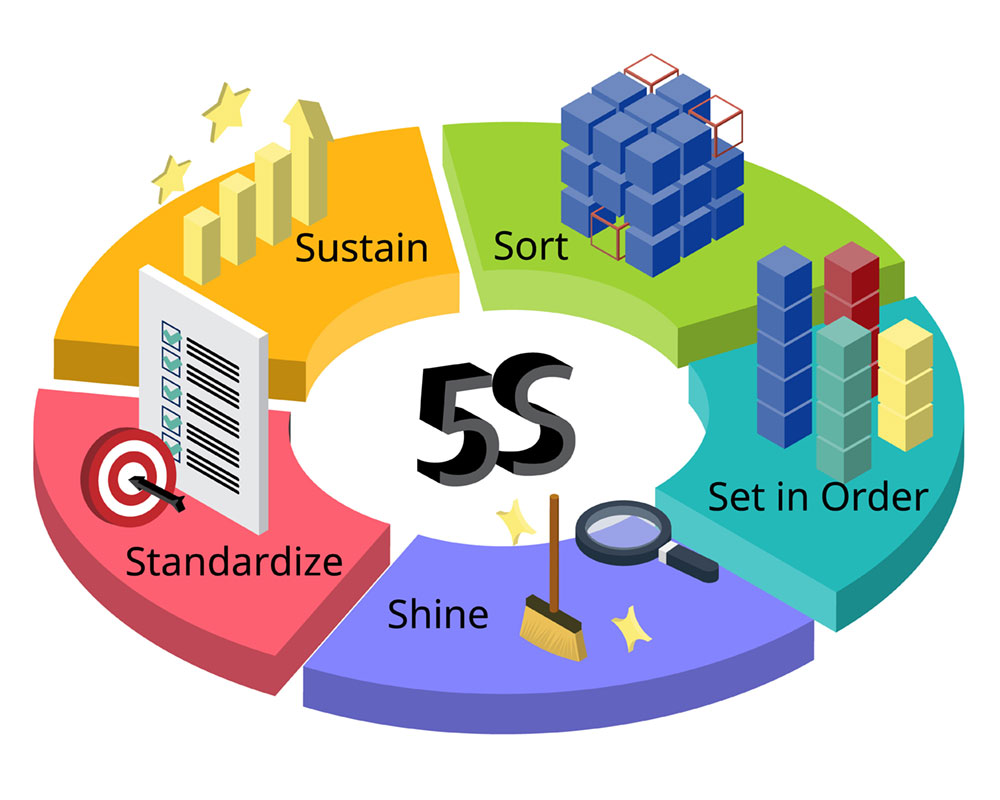
The 5S methodology focuses on workplace organization. The idea behind it is that when the workplace is organized, both efficiency and safety improve. As is evident from the name, there are 5 steps in this methodology, all starting with the letter s. Hence, the name 5S.
Expanding 5S
Sort – Sorting refers to going through all the elements in the workspace, retaining only what is needed and getting rid of anything that is unnecessary. Sorting is not a one-time project – it needs to be done at regular intervals to make sure the workspace stays organized.
Set in Order–Setting in order means keeping all the necessary tools accessible so that no time is wasted in looking for things. Typically, while setting up the workspace, tools needed frequently are positioned within reach ensuring smooth workflow.
Shine –Shine refers to cleansing the workspace at preset intervals of time so that tools are maintained in good condition and any problems are picked up early. This component of 5S also helps promote an aesthetic workspace that employees feel happy to work in.
Standardize–Standardization refers to putting standard operating protocols in place for the aforementioned steps of sort, set in order and shine.
Sustain–This involves making sure the processes are sustained over time so that one-time efforts are changed into habits.
The 5S methodology can be applied to any kind of organization. From factories to healthcare organizations, any space where physical tasks play a crucial role can benefit greatly from 5S.
What Is Kaizen?
The word Kaizen is an amalgamation of two Japanese words – kai meaning change and zen meaning good. Combined together, it spells out the philosophy of Kaizen – small, incremental changes which add up over time to result in significant growth for the organization.
The principles of Kaizen can be summarized as follows:
The PDCA Cycle
The PDCA cycle or the Plan-Do-Check-Act cycle is an iterative cycle that aids in the implementation of Kaizen.
5S and Kaizen Go Hand-in-Hand -H2
5S provides the foundation on which Kaizen can be implemented. Kaizen in return ensures that the benefits from 5S are maintained. 5S keeps encouraging employees to find better ways of workplace organization and Kaizen promotes process and product improvement. Together, they help make improvement and growth a natural and permanent part of the organization.
Summarizing the Key Benefits
In the Hospital Setting
With the incorporation of AI into healthcare, healthcare technology has improved greatly. But the core issues remain – affordability, quality and equity. Healthcare professionals are often expected to do more with less without compromising on the quality. This is an example of a situation where 5S implementation can result in many benefits:
Furthermore, 5S implementation is easy – it does not involve extensive training or complex concepts. As it is logic-driven, all employees can implement it.
At Kauvery
Kauvery Hospital being a key player in healthcare is well-aware of its responsibility to the public. The hospital incorporated the 5S methodology to improve efficiency, reduce waste and promote safety. The prestigious 5S Platinum Medal and Certification that was bestowed on it is a testament to the hospital’s commitment to continuous improvement and waste reduction, which help achieve its vision of providing the best healthcare at affordable costs.
Frequently Asked Questions
What is the main difference between 5S and Kaizen?
5S focuses on workplace organization and efficiency, while Kaizen emphasizes continuous, incremental improvements involving all employees.
Can 5S and Kaizen be used together?
Yes, 5S provides the foundation for organization, while Kaizen ensures ongoing improvements, making them complementary methods.
How does Kaizen use the PDCA cycle?
Kaizen applies the Plan-Do-Check-Act cycle to test, measure, and refine small changes, leading to long-term improvements.
What are the benefits of applying 5S in hospitals?
5S improves staff efficiency, reduces errors, increases safety, maintains cleanliness, and ensures consistent patient care quality.
Why did Kauvery Hospital adopt 5S methodology?
Kauvery Hospital implemented 5S to improve efficiency, reduce waste, enhance safety, and provide affordable, high-quality patient care earning the 5S Platinum Medal Certification.
Is 5S easy for employees to learn and apply?
Yes, 5S is logic-driven, simple to understand, and requires minimal training, making it suitable for all workplace environments.