What Is Corporate Social Responsibility?
- Jan 21, 2026
 Overview:
An organization has to act responsibly towards the society which enables its survival, provides it with resources, and is affected by its operation. This requirement of the organization is called corporate social responsibility or CSR. The blog explains this concept in detail.
Corporate social responsibility (CSR) refers to an organization having a positive impact on the society while meeting its commitment to its stakeholders.
Companies which practice CSR are aware of their duty to the society, be it social, environmental or economic. They look beyond just monetary profit and understand that true fulfillment comes from making a positive difference to people’s lives.
The Three Ps of CSR
People, planet and profit are the 3 Ps that lay the foundation for organizations to practice CSR. Also called the “Triple Bottom Line”, they define the impact of practicing CSR.
-
The First P
Heartfelt dedication to the well-being of people forms the basis of CSR. People refers to not just employees, but also customers and the society at large. When businesses give people the importance they deserve, they succeed in building long-lasting relationships.
-
The Second P
This involves protecting our planet from the negative effects of industrialization.
-
The Third P
While any organization needs to be financially sustainable, aligning profit with purpose can strengthen the organization’s standing in the society.
Types of CSR
CSR is categorized into 4 types with each type focusing on the action to be taken in that particular area. In other words, they are the strategies that can be employed to achieve the 3 Ps.
Environmental Responsibility
This refers to organizations acting to reduce their ecological footprint and also working to make the planet a better place to be in. Actions include:
- Waste reduction by using recyclable materials, practicing composting and stopping usage of single-use plastics.
- Using sustainable energy sources, reducing fossil fuel consumption, and sourcing materials from companies that prioritize sustainability.
- Planting trees, funding research and contributing to worthy environmental causes.
Ethical Responsibility
This refers to an organization acting with honesty and integrity. Treating shareholders, employees and customers fairly, forms part of ethical responsibility. Ways to embrace ethical responsibility include:
- Being transparent with all those who are involved with the organization – being open and honest about the company’s financial position and the way forward.
- Cultivating a diverse culture of belonging and capability.
- Ensuring safe workspaces and competitive wages for employees.
Philanthropic Responsibility
Philanthropy in CSR usually refers to companies voluntarily pledging a part of the profit to a good cause, typically one that aligns with the values of the company.
- Companies can either donate to charities or even create charities that focus on a cause.
- Usually, employees are also involved in some way which promotes a feeling of purpose, pride and community.
Economic Responsibility
- This is a combination of the above 3 types wherein businesses merge their values with their financial decisions, keeping in mind the greater good on the society.
- Decisions are taken with empathy and go beyond just having monetary profit as the focus.
The Many Benefits of CSR
An organization can benefit in many ways when it adheres to the principles of CSR:
- Organizations that practice CSR enjoy an enhanced brand image earning the respect of the community. This can give them a huge competitive advantage.
- Customers take pride in being associated with a socially responsible company and this promotes both customer satisfaction as well as retention.
- Increasing operational efficiency by reducing waste and employing sustainable technologies not only benefits the environment but also results in cost savings.
- Employees are proud to work in organizations that are socially responsible – this plays a huge role in employee attachment which leads to reduced turnover.
- Organizations that practice CSR are more likely to find investors as they are considered safer investment options.
Kauvery Hospital and Corporate Social Responsibility
“As the organization grows, the society and community around it should also grow.”
This is the foundational principle that drives Kauvery’s commitment to enhancing the well-being of the people.
We have pioneered a number of initiatives to transform our society for the better. A few of them are mentioned below:
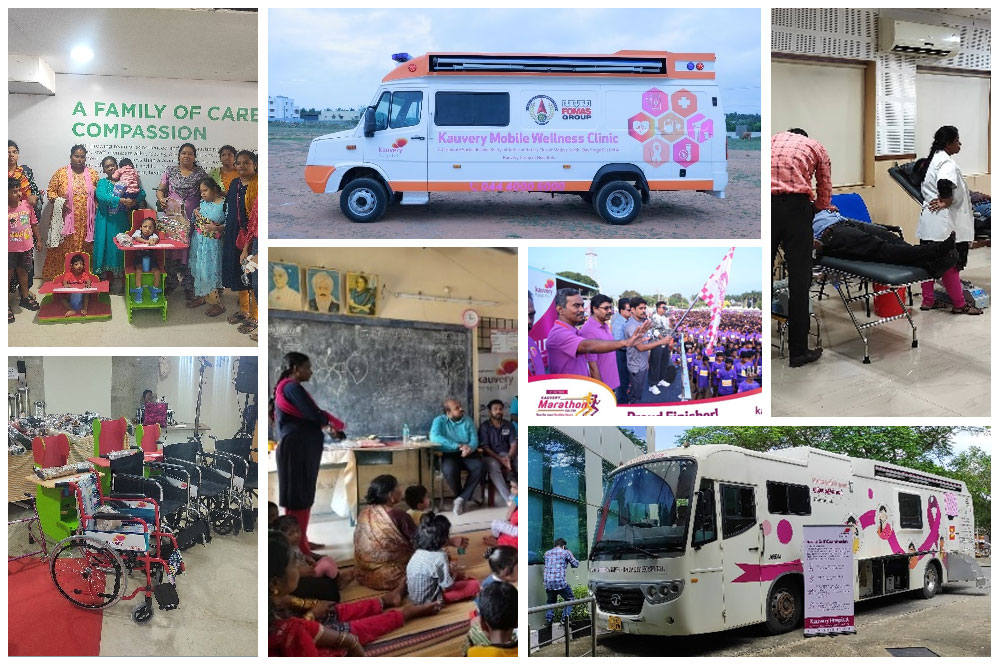
- Mobile Wellness Clinics: Launched with the aim of bridging the gap in healthcare accessibility in suburban areas, these mobile wellness clinics provide free medical screenings and consultations to the underprivileged. Equipped with advanced diagnostics, they facilitate early detection of health conditions to improve outcomes and make a difference to people’s lives.
- Mobile Mammogram Bus: This bus brings free breast cancer screenings to women in an effort to promote early detection of breast cancer. Stationed in various rural and underprivileged areas of Tamil Nadu, the mobile mammography unit is Kauvery’s initiative to make sure women do not miss out on essential screenings due to reasons like accessibility or cost.
- Rural Health Camps: Free health camps are conducted in rural and under-served areas focusing on preventive care and early diagnosis. These critical interventions reduce the burden of preventable conditions and improve overall community health.
- The Shine Initiative: Through this initiative, life-saving cardiac surgeries are performed on underprivileged children with heart issues. The initiative also spreads awareness on cardiac conditions in children.
- Project Jeevan: Under this project, Kauvery Hospital offers free spinal surgeries to underprivileged children thus ensuring that financial difficulties do not stand in the way of a healthy future.
- Installation of Automated External Defibrillators (AEDs) in Public Spaces: To assist individuals who suffer sudden cardiac arrest, Kauvery Hospital has installed AEDs in public places like railway stations, parks and community centres. By making available this life-saving equipment, Kauvery hopes to increase the chances of survival for those experiencing cardiac arrest outside the hospital setting.
- Awareness Programs: Kauvery Hospital regularly conducts awareness programs and local events (like the K10K Run and the Kauvery Marathon) to spread information on a number of conditions for the benefit of the public. The aim is to empower people with the right information so that they can take charge of their health.
- Blood Donation Drives: These drives are organized regularly in various locations to support urgent patient needs.
- Environmental Consciousness: Committed to sustainability, Kauvery safeguards as well as enhances the environment in a number of ways.
- The hospital’s energy consumption is 79-90% renewable energy.
- Single-use plastic is dispensed with and composting and recycling are practiced.
- Planting trees, rainwater harvesting and the use of electric vehicles are the other environment protection initiatives the hospital embraces.
- The hospital has also been awarded the LEED certification which recognizes its commitment to sustainable and environmentally-responsible healthcare infrastructure.
- Youth Development: To encourage students, Kauvery Hospital has contributed to philanthropic organizations that support student education. The Career and Competency Development Program focuses on rural students to help them upskill and become more competitive.
At Kauvery, we are focused on creating a positive impact that goes beyond just healthcare – we believe in nurturing potential, providing opportunities, and shaping a better future for our country.