Disability Inclusion and Accessibility
- Feb 13, 2026
 16% of the world’s population has some form of disability. This translates to 1.3 billion people. These disabilities span a number of conditions ranging from physical and intellectual to mental health-related and sensory.
Some forms of disabilities are apparent while others are not. Irrespective of whether it is obvious to us or not, every form of disability requires the same respect, support and understanding. This means we have to intentionally practice disability inclusion and ensure accessibility for all.
Most people are often unaware that people with disabilities are marginalized or left out. By just shedding light on the topic, we can encourage more inclusive actions and attitudes.
What Is Disability Inclusion?
Disability inclusion means making sure all people, irrespective of the way they talk, move, think or communicate, get the same opportunities in all aspects of life. Unfortunately, this is not today’s reality. People with different abilities are excluded, intentionally or unintentionally, by society. This exclusion affects not just adults, but children too.
People with disabilities face discrimination in all aspects of life – be it as students, in their careers, as members of the society, or even within their own families and communities.
This limits their access to education, employment, healthcare, and social participation, and ultimately affects their ability to live lives of dignity.
Understanding Accessibility
Accessibility is a key component in addressing the exclusion of people with disabilities.
The United Nations defines accessibility as “a fundamental right and essential precondition for persons with disabilities to live independently, participate fully in society, and enjoy equal access to the physical environment, transportation, information, and communication technologies (ICT).”
Putting Disability Inclusion and Accessibility into Practice
This starts when we stop “adjusting” to people with disabilities and instead focus actively on truly understanding their perspective. Some simple changes can make a world of difference:
Inclusive Communication: This might seem like a simple thing but how we speak influences the way we think. It is important to use people-first language.
- There is huge difference between “people with disabilities” and “disabled people”. The former stresses on the person while the latter defines the person by their disability.
- The same applies while referring to people who use wheelchairs. Using terms like “wheelchair-bound” or “confined to a wheelchair” highlights the disability instead of the person.
- It is also important to remember that while addressing people with disabilities, we need to address them directly and not their family members or companions as this once again undermines their independence.
Apply Universal Design: Practice inclusion in the design stage itself rather than modifying things later. Given below are a few practices that should be made the norm.
- Physical Environment: Designing all public spaces (buildings, parks, entertainment centres, and roads) with accessibility provisions like ramps, appropriate signages, and other necessary features.
- Access to Information: Providing information in various formats like Braille, large print, sign language, etc. to ensure that information reaches everybody.
- Digital Accessibility: Making websites and apps screen reader compatible and following the Web Content Accessibility Guidelines (WCAG) to make content accessible to everyone.
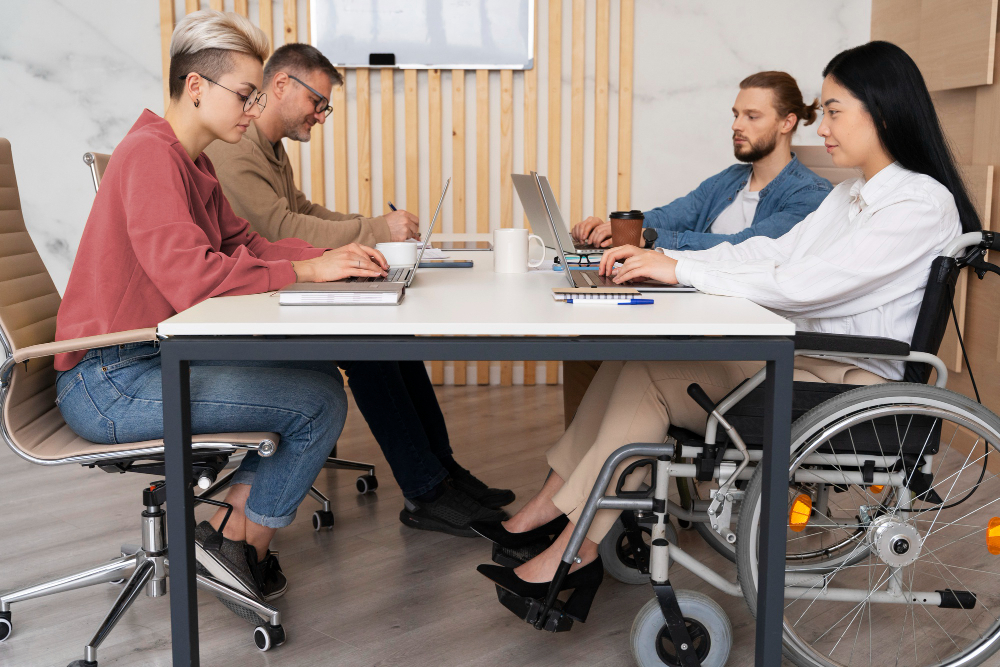
Inclusive Workspaces: An inclusive workspace is both a moral obligation as well as a competitive advantage. These workspaces not only benefit from better productivity but also improved retention. A few strategies to develop an inclusive workspace include:
- Designing workspaces to accommodate everybody rather than waiting for people to disclose a disability.
- Having flexible working hours to support diverse physical and mental health needs.
- Making sure recruitment practices are inclusive without language that discriminates against people with disabilities, and ensuring recruitment forms are available in a number of formats (like audio) to give an opportunity to all.
Advocate for Change: Be an active ally for people with disabilities. There is a world of difference between maintaining neutrality and actively campaigning for change.
- Educate yourself on the diverse conditions people may have. Learn how these affect them. This will help you understand their situation better.
- Stand up against discriminatory practices and language.
- Support policies that protect the rights of people with disabilities.
Finally, remember that all the above changes will be irrelevant if you do not include people with disabilities while taking decisions concerning them. Make sure to actively seek their input and involve them in the decision-making process.
How Accessibility Features Can Benefit All: The Curb-Cut Effect
Curb-cuts refer to the small ramps that are part of sidewalks and are meant for people who use wheelchairs. Though they were meant to facilitate wheelchair mobility, they ended up being useful for others too: parents with strollers, travellers with luggage, people with delivery carts, and the elderly with walkers.
Initially meant only to help people with disabilities, this feature ended up helping all. With respect to the bigger picture, it gave rise to the idea that accessibility features will ultimately benefit all.
Some more examples include:
- Videos with Subtitles: Meant for people with hearing impairments, this feature extended to helping people with language barriers and those watching videos in noisy environments.
- Automatic Doors: Meant for people with physical disabilities, automatic doors also helped the elderly and those carrying heavy items.
What we need to understand from the curb-cut effect is this: When we design keeping in mind those with the greatest need, everyone benefits.
In Conclusion
Disability inclusion is not a favour we extend to others; it is a fundamental human right and it is our duty to ensure it is upheld.
To do this, we first need to understand that this exclusion is not inevitable – rather it is a way of thinking that has been ingrained in us for many years. This has to change – it is up to us to question our biases, challenge outdated norms and create a society where everyone is given the opportunity to live up to their true potential. And the fundamental block to that change is awareness.
Frequently Asked Questions
1. What Is Disability Inclusion?
Disability inclusion means ensuring that people with disabilities have equal opportunities in education, employment, healthcare, and society. It focuses on removing barriers so everyone can participate fully and live with dignity.
2. What Does Accessibility Mean?
Accessibility refers to designing environments, products, and services so that people with disabilities can use them independently. The United Nations defines it as a fundamental right for full participation in society.
3. What Is Universal Design in Accessibility?
Universal design means creating spaces, systems, and products that are usable by all people without needing special adaptations. Examples include ramps, subtitles, screen-reader-friendly websites, and automatic doors.
4. Why Is Disability Inclusion Important in Workplaces?
Inclusive workplaces improve productivity, employee satisfaction, and retention. They also promote diversity, innovation, and equal opportunities while creating a supportive environment for all employees.
5. What Is the Curb-Cut Effect?
The curb-cut effect shows how accessibility features benefit everyone. For example, ramps designed for wheelchair users also help parents with strollers, travelers with luggage, and elderly individuals.
6. How Can We Promote Disability Inclusion in Daily Life?
- Use respectful, people-first language
- Support inclusive policies and practices
- Design spaces and content for accessibility
- Educate yourself and others about disabilities
- Involve people with disabilities in decision-making